

The optimistic era of climate diplomacy, epitomized by the 2015 Paris Agreement, has given way to a more fragmented world in which climate change has taken a back seat.
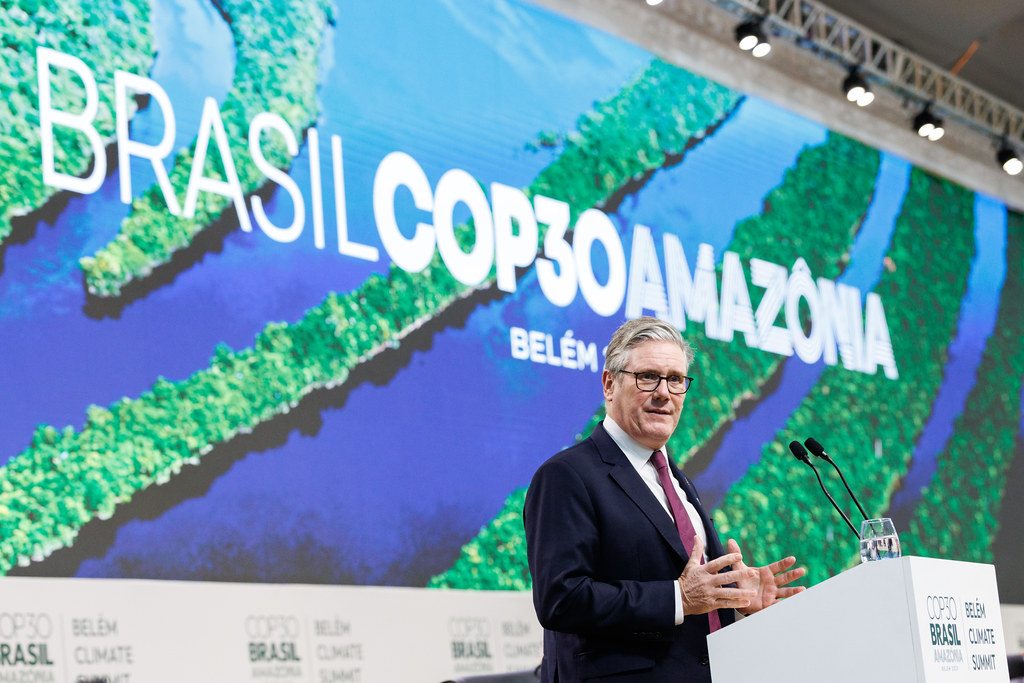
This year’s United Nations Climate Change Conference, known as COP30, opened in Belém, Brazil, with a stark reality check from UN Secretary-General António Guterres: The world has now passed 1.5 degrees Celsius of average warming above preindustrial temperatures. While climate scientists had begun acknowledging that this trajectory was likely, climate negotiators and diplomats understandably have until now preferred an optimistic outlook on the 2015 Paris Agreement ambition to keep temperatures below 2 degrees of warming. And after a woefully weak final agreement, COP30 also ended with another harsh reality: The cooperative and optimistic era of climate diplomacy, epitomized by the Paris Agreement, has given way to a more fragmented and competitive world, in which climate change is taking a back seat to other concerns.
The current U.S. administration has undoubtedly exemplified this shift. President Trump has called climate change a “con job,” as his administration openly torpedoed the International Maritime Organization negotiations, and COP30 featured no official U.S. government representative. While few countries have gone as far as the United States in rejecting climate action, there’s no denying that ambitions have wavered and political urgency has waned across the board. An overwhelming majority of countries—95 percent—were late with their Nationally Determined Contributions, which were the pledges due at this summit to set ambitions for the next decade. And when they arrived, they added up to well under what’s needed to meet the Paris goals.
Despite this gloomy picture, it’s important to acknowledge that significant progress has been made since Paris. The world was on a trajectory for 4 degrees of warming before 2015. Thanks to the COP process and bold climate action from many partners, we’re now closer to 2.5 to 3 degrees. Shaving off 1 degree matters: The reduction will likely save countless lives and livelihoods in the decades to come. Clean energy investments continue to grow, led largely by China, but also by national-level and private-sector innovation. And despite weak final agreement language on emissions, COP30 attendees agreed on other notable initiatives, including the adoption of adaptation indicators to measure country progress and a call for tripling adaptation finance by 2035. Convening 194 countries to grapple with the most challenging issues facing the world can still achieve progress, even if insufficient.
The outcome of COP30 underscores the growing challenges countries have cooperating in the face of an increasingly complex landscape of state and non-state threats from increasingly visible climate security impacts to economic coercion and hybrid warfare. Against this backdrop, COP negotiators were acutely aware of an environment that now includes the sharpening intersection of geopolitical competition and climate politics; the rising urgency of investment in adaptation to manage the climate security impacts unfolding today; and the need to prepare for growing international attention to more radical climate interventions, such as solar geoengineering, as the world falls short of the 1.5 degree target.
COP30 Reflected a Fragmented World
COP30 underscored how much climate diplomacy can shift in just a couple years. In 2023, a U.S.-China agreement on methane ahead of the United Arab Emirates-led COP28 sent a signal to the rest of the world that the two largest emitters were ready to lead. That COP also saw an agreement to create the Loss and Damage Fund, the first-ever COP commitment to “transition away” from fossil fuels, and 95 countries signed a declaration on the nexus of climate change, conflict, and the need to provide finance in the most fragile states. Fast-forward just two years and the picture from Belém was much different.
For the United States, the Trump administration’s abrupt reversal on U.S. climate leadership—including a withdrawal from key agreements, a rollback of domestic green policies, and dismantling of the agency responsible for adaptation and global development—has left many countries questioning whether Washington remains a reliable partner on climate action. In this vacuum, though it stayed relatively quiet in Belém, China continues to expand its global influence through clean energy finance and technology exports, leveraging its dominance in solar, batteries, and electric vehicles to position itself as an indispensable player in the energy transition.
Absent strong leadership from the U.S. and China, COP30 negotiations sputtered; the final agreement took a step backward by not mentioning fossil fuels and resulting in only minimal new commitments of climate finance. To navigate this new more competitive environment among great powers, developing countries framed issues like climate justice, debt relief, indigenous representation, and finance as sovereignty and security issues. Meanwhile, middle powers aimed to leverage the COP as a platform to elevate themselves and their national industries, with mixed success. Oil-producing Saudi Arabia was able to ensure weak language on emissions, Indonesia used the meeting to sell carbon credits, while host nation Brazil failed to secure much funding for its marquee new fund for forests.
Critically, COP is no longer the only game in town for climate cooperation. With bilateral and minilateral cooperation on some issues thriving, private-sector development continuing to grow, and security interests taking up a larger share of national budgets and policy attention, leaders are coming face-to-face with this climate reality: COPs are becoming arenas for soft-power projection and contestation, rather than problem-solving.
Adapting to the Unavoidable: The 1.5-Degree Reality Check
One bright spot at COP30 was the focus on adaptation, though it remains to be seen whether this emphasis will deliver on the meeting’s ambitious goals in this area. Nonetheless, this year’s COP has been the most forward-leaning on adaptation measures, establishing for the first time a set of adaptation indicators against which countries will be measured. The meeting also emphasized new sources of financing, datasets, and tools to make it easier to shift away from traditional, mitigation-focused efforts.
Global leaders already face a massive adaptation gap: Current funding and planning fall far short of the current scale of need, which continues to spread to new regions and sectors. While fragile states and sectors already face destabilization risks from climate change, the Global North is also increasingly finding itself on the back foot after record droughts, storms, floods, and wildfires. Climate change is impacting global stability, with water, food, and energy insecurity driving migration, conflict, and political unrest.
These factors often exist in an intractable vicious cycle. Examples of this phenomenon include the intersection among rainfall cycles, displacement, and conflict in Somalia; drought and displacement ahead of the 2011 Syrian civil war; and more. Notably, when climate change and security intersect, the effects are rarely limited to national borders. Instead, effects tend to reverberate outward due to increased migration, interrupted supply chains, and potential recruitment for non-state armed groups. Without adequate planning and funding, a localized climate disruption can grow to a national—or even regional—disaster.
Recognizing the challenges ahead, both military and humanitarian actors are preparing for these cascading crises, but they need more funding and emphasis on long-term adaptation planning, not pressure from governments or donors to narrowly focus on mitigation. As demonstrated by the cascading risks of a world rocketing past 1.5 degrees, investment in adaptation is not just good development policy—it’s a strategic necessity.
***
Ultimately, COP30 may mark a shift in global climate cooperation. Unlike the political consensus and goodwill that drove the Paris climate accords in 2015, today’s COPs are yielding little more than political rhetoric and unfunded promises. Going forward, the real action will likely be in national strategies, regional blocs, public-private partnerships, and coalitions of the willing.
Instead of clinging tight to the COP system, the challenge for policymakers will be to manage this shift without letting climate governance fracture entirely. This will require them to embrace today’s climate realities: practicing realism about the limits of mitigation, placing more emphasis on adaptation, recognizing the stability challenges to come, and being pragmatic about the venues for cooperation in today’s geopolitical environment.
– Erin Sikorsky, Siena Cicarelli, Published courtesy of Lawfare.
