

Researchers show changes to benchmarking method, auctioning ratio, and carbon pricing impact different types of power generation companies differently
South Korea has ambitious climate goals, with a strong focus on reducing greenhouse gas emissions from its electricity sector. To this end, Korea launched the Korean Emissions Trading Scheme (K-ETS) in 2015: a policy that sets limits on companies’ emissions and allows them to trade emission permits or allowances. However, the K-ETS has faced structural challenges, prompting the government to propose reforms in the fourth implementation phase (2026-2030). Importantly, the K-ETS and the proposed reforms are largely based on the European Union Emissions Trading System (EU-ETS). So, whether the reforms will deliver EU-like outcomes in Korea’s electricity sector is uncertain, as market conditions in the EU and Korea are vastly different.
To explore further, a research team from South Korea, led by Assistant Professor Dowon Kim from Pusan National University, analyzed how the proposed K-ETS reforms would affect the electricity market, specifically the power generation sector. Prof. Kim emphasizes, “The power sector is expected to contribute nearly 44.3% of Korea’s total national emissions reduction target, making it critical to understand the interaction between K-ETS reforms and electricity market operation.” Their study was made available online on April 24, 2026, and published in Volume 215 of Energy Policy in August 1, 2026.
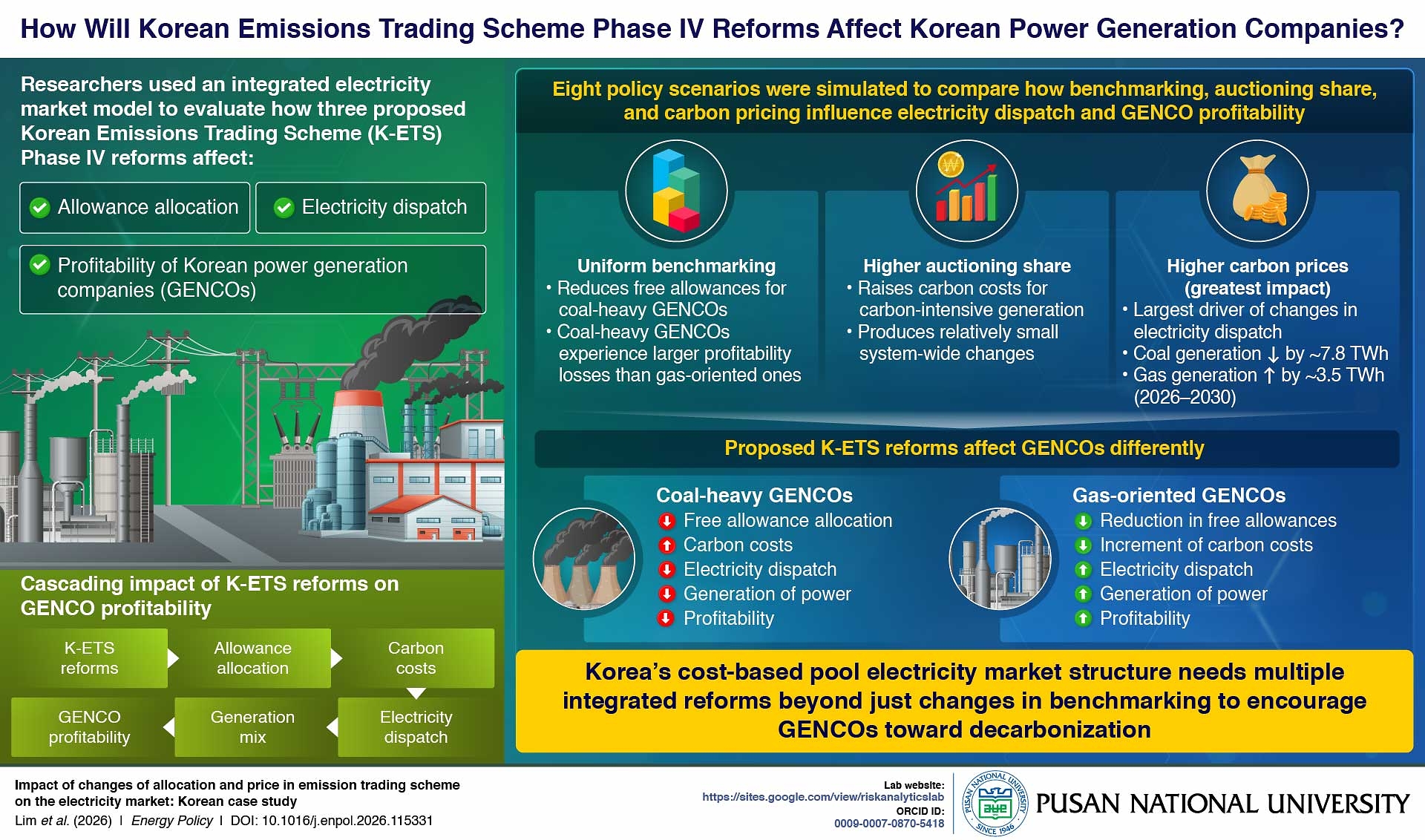
Researchers first developed a computational model of the Korean electricity market. They then applied it to multiple scenarios containing different combinations of three policy variables: first, a fuel-specific versus a uniform benchmark (the standard for receiving free emission allowances varies for power plants depending on their energy source, whereas the proposed reform suggests a single standard for all plants); second, the current versus the proposed increase in auctioning share (or percentage of allowances that companies must buy through auctions); and third, the current versus the proposed increase in carbon pricing (or cost charged for producing emissions).
Analysis revealed that shifting from a fuel-specific to a uniform benchmark reduced free emission allowances and profits of fossil fuel-based power generation companies. Coal-based companies faced sharp profit declines, whereas natural gas-based companies were less affected. Furthermore, increasing the auctioning share raised the cost of generating an additional unit of electricity, particularly for coal-based companies. It thereby provided a gentle nudge toward lower-emission fuels like gas. However, the effects of these two reforms were small.
The strongest impact came from increasing carbon pricing, which raised both electricity generation and emissions costs more for coal than for gas, leading companies to partially shift from coal to gas.
In conclusion, Prof. Kim emphasizes, “The proposed K-ETS reforms should be implemented along with complementary measures, like targeted investment and transitional support, to maximize their impact, mostly because Korea’s electricity market is highly centralized and limits companies’ ability to recover rising costs by charging consumers more.” Integrated policies are thus necessary to drive electricity decarbonization while protecting the stability of the power sector.
